
Energy Roof Solar-Thermal System
Objective: Prove out a factory-built solar roof that keeps the weather out, makes electricity, and captures the sun's heat, then size a full-scale prototype that is ready to build.

Client: Energy Roof Systems LLC
Role: Vice President, Energy Roof Systems; lead engineer for thermal analysis and prototype engineering (Bedatek)
Scope: Concept engineering, conjugate heat-transfer CFD, hour-by-hour seasonal energy modeling, prototype sizing, and technical reporting
Tools: SolidWorks, SimScale CFD, NREL PVWatts weather data, custom hourly energy model
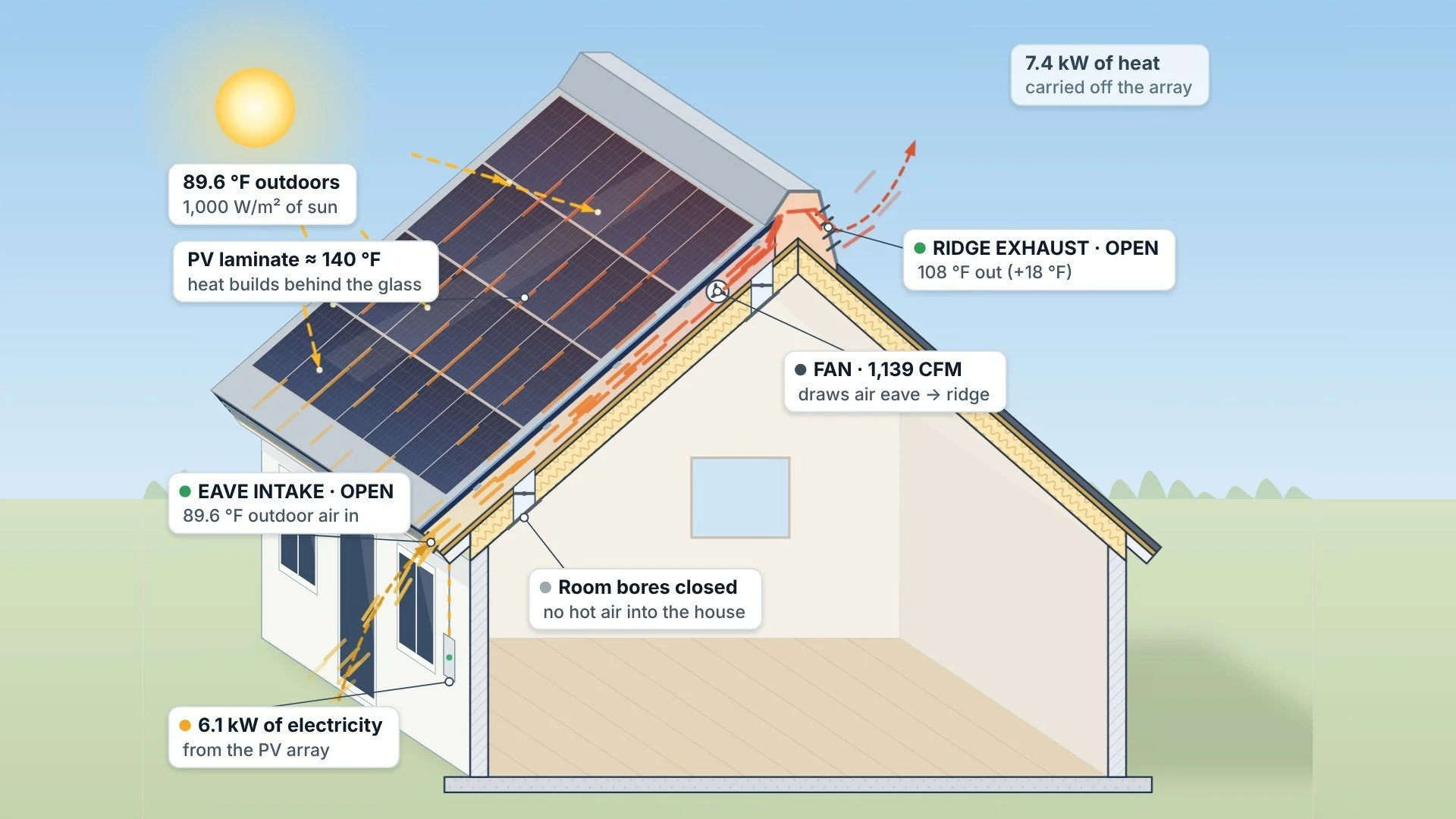
Overview: The Energy Roof is a factory-built solar roof that replaces conventional roofing outright. A standard solar panel turns only a fraction of the sunlight that strikes it into electricity, and most of the rest is lost as heat. The Energy Roof captures that heat with air moving beneath the glass, so a single roof plane does three jobs: it weatherproofs the building, generates electricity, and delivers useful heat.
Bedatek led the engineering behind the full-scale prototype: modeling how air and heat move through the roof in every season, confirming it stays safe on the hottest day with the fan off, and turning the results into clear build decisions for the team and its partners.
CFD laminate temperature field on the 7 × 4 prototype model in summer (top) and annual useful energy compared with a standard solar roof (bottom)
The Challenge
Solar-thermal roofs promise more energy from the same roof, but the case rests on physics that is easy to overstate. Before committing to a full-scale prototype, the team needed defensible answers to three questions: how much useful energy the larger roof would deliver over a real year, whether it would stay within material temperature limits if the fan stopped on a summer afternoon, and whether winter heating was worth the added hardware.
Thermal Modeling (CFD)
Bedatek built a finite-volume conjugate heat-transfer model directly from the roof's 3D CAD assembly, solving heat flow through the glass, solar cells, air channel, and roof deck together. Three operating cases were studied:
Summer, fan on: outdoor air drawn up the slope to cool the panels and harvest heat
Summer stagnation, fan off: the worst case, with the roof venting itself by natural buoyancy like a chimney
Winter recirculation: indoor air looped through the roof to collect solar heat for the house
An air-gap sensitivity study set the channel depth, and heat-transfer results were anchored to data measured on full-scale systems of the same family, keeping the numbers deliberately conservative.
Seasonal Energy Model
A single design-hour snapshot does not tell an owner what the roof returns over a year. Bedatek paired the CFD results with an hour-by-hour model of a representative Connecticut year to total the electricity, summer heat harvest, and winter space heating the roof delivers, and to compare it on equal sunlight with a standard solar roof.
Prototype Sizing
The analysis supported growing the prototype from a 6 × 3 array to a 7 × 4 array of 28 modules on a 28 × 16 ft roof, the size and proportion of a real residential roof plane. The smaller array was re-run in the same model so every comparison reflects the design change, not the tool.
Clear Reporting
Findings were delivered as formal technical reports with a plain-language summary after each section, plus a one-page summary for partners and investors, so engineers, architects, and non-technical readers could all follow the build decision.
Results
About 2× the useful energy of a standard solar roof: roughly 16,950 kWh per year (9,300 kWh of electricity, 5,400 kWh of summer heat, and 2,250 kWh of winter space heat)
23% of incident sunlight turned into useful energy, versus 13% for a PV-only roof
49% more useful energy than the earlier 6 × 3 array on the same modeling basis
Safe with the fan off: about 140 °F average and 146 °F peak at stagnation, leaving roughly 48 °F of margin to the material rating basis
Winter heating for about 900 hours per season, including useful heat on sunny sub-freezing days
A clear go decision: the full-scale prototype design was confirmed and ready for fabrication and instrumented testing