
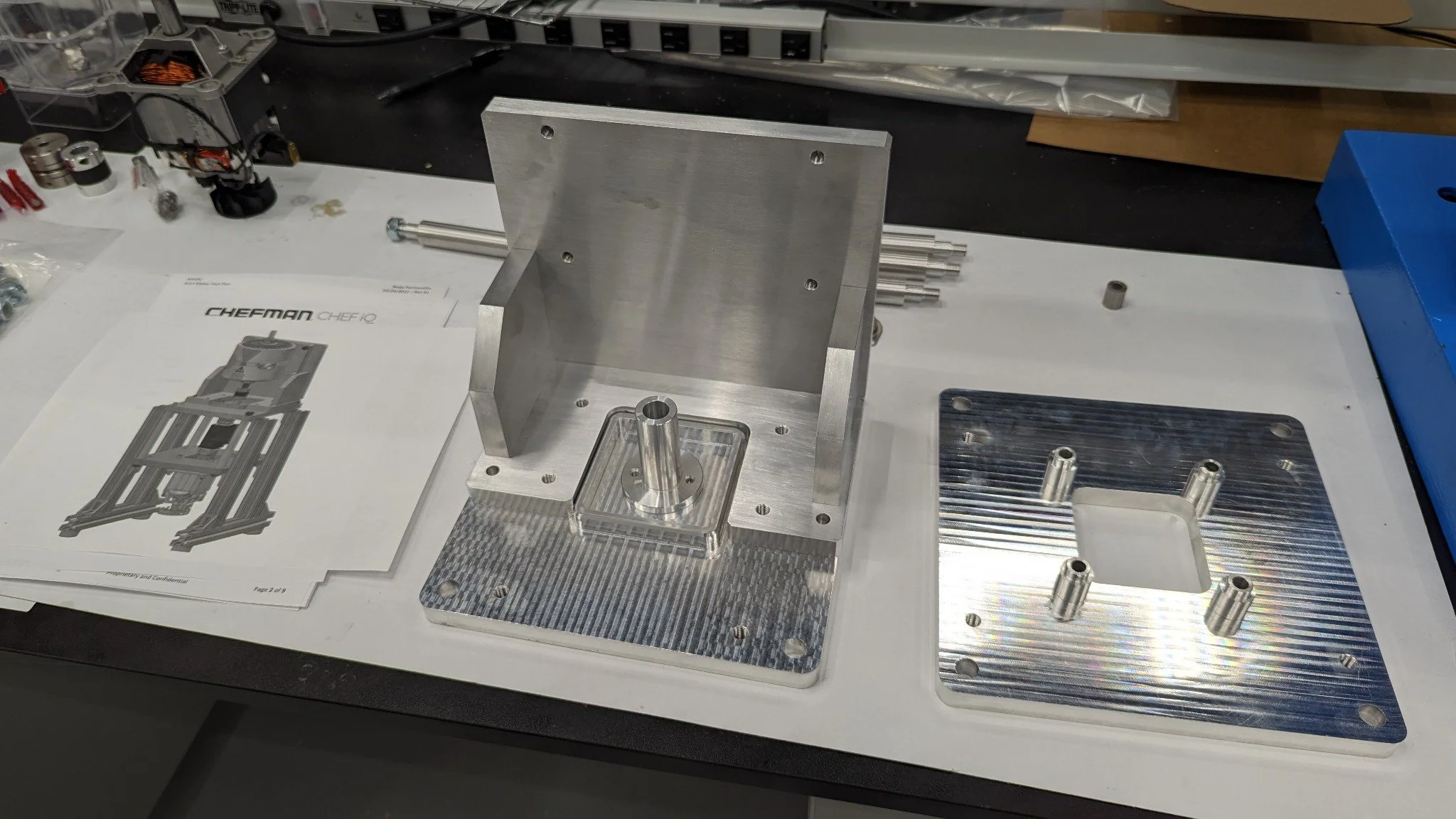
Motor Characterization Fixture
Objective: Design and develop a high-precision motor characterization test fixture capable of accurately quantifying electric motor performance through simultaneous measurement of torque and electrical output (voltage) as a function of rotational speed (RPM). The system was engineered to operate under controlled and repeatable boundary conditions, enabling consistent evaluation of motor behavior across varying load states and operating regimes.
Role: Mechanical Design Engineer
Organization: Chefman
Key design objectives included minimizing system-induced error sources such as shaft misalignment, structural compliance, and vibration, while ensuring high fidelity in sensor measurements and data acquisition. The fixture was intended to support performance benchmarking, efficiency analysis, and validation testing, providing engineers with reliable datasets for design optimization and comparative analysis.
Overview: This project encompassed the end-to-end design, engineering, and fabrication of a fully integrated motor characterization fixture, developed entirely from first principles. The system combines mechanical structure, precision alignment features, sensor integration, and data acquisition interfaces into a compact and robust test platform optimized for repeatable and accurate performance measurement.
At its core, the fixture utilizes a dynamometer-based architecture, where the motor under test is mechanically coupled to a controlled load system. This configuration enables direct measurement of output torque under varying rotational speeds, while simultaneously capturing electrical response parameters. The integration of synchronized sensing allows for the generation of complete performance curves, including torque-speed and voltage-speed relationships.
The mechanical design emphasizes coaxial alignment of rotating components, achieved through precision-machined interfaces and rigid structural support. This minimizes radial runout and parasitic loading, ensuring that measured torque values reflect true motor performance rather than system-induced artifacts. The structural framework was engineered to maintain high stiffness and low deflection under dynamic loading, preserving measurement integrity throughout the test cycle.
Instrumentation and data acquisition systems were integrated to enable real-time monitoring of key performance variables, supporting both steady-state and transient testing conditions. The system architecture allows for controlled loading scenarios, facilitating detailed performance mapping across the motor’s operational envelope.
Overall, the fixture delivers a repeatable and scalable testing solution, enabling engineers to conduct high-quality experimental validation, characterize motor efficiency, and inform design decisions with confidence. The design balances precision engineering, practical manufacturability, and operational usability, making it suitable for both development environments and structured validation workflows.
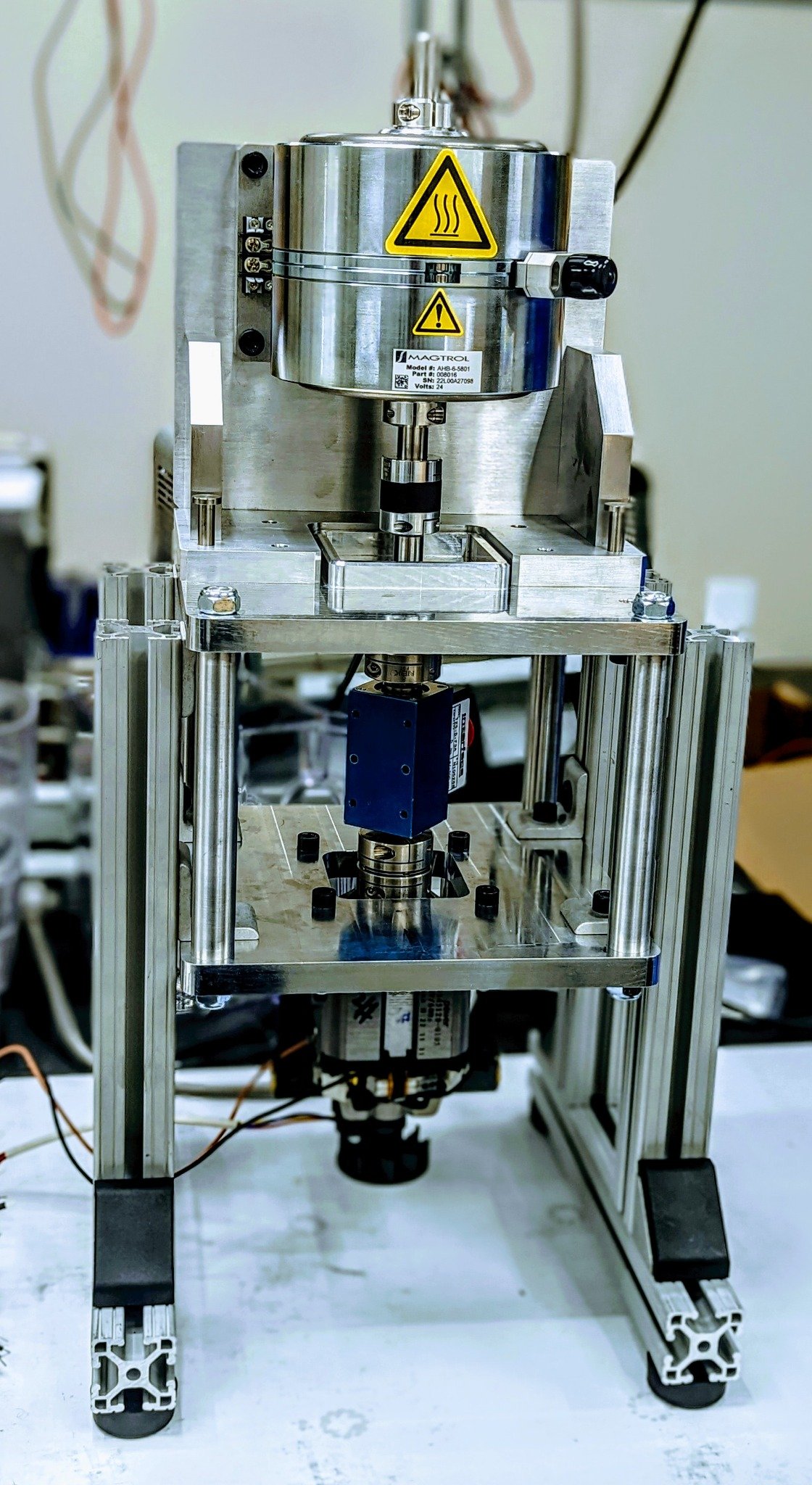
Fully Assembled Test Fixture
Fully integrated motor characterization fixture demonstrating rigid structural architecture, precise axial alignment, and repeatable test configuration.
-
The fixture was constructed using precision CNC-machined 6061-T6 aluminum components, selected for their optimal combination of strength-to-weight ratio, machinability, corrosion resistance, and dimensional stability under load. Critical interfaces were manufactured with tight geometric tolerances to ensure coaxial alignment between the motor shaft, coupling interface, and dynamometer input shaft, thereby minimizing runout, eccentricity, and parasitic loading conditions that could introduce measurement error.
Precision-machined mounting features, including locating dowel interfaces and orthogonal reference planes, were incorporated to establish repeatable assembly alignment and ensure accurate load transmission across the system. The structural architecture was designed to mitigate deflection and compliance under dynamic loading, maintaining consistent boundary conditions during testing.
A rigid base frame and support structure was implemented to support both the motor and dynamometer assemblies, ensuring structural integrity while preserving alignment across all mechanical interfaces. The design maintains tight tolerances across all load-bearing and alignment-critical features, reducing vibration-induced error and improving measurement fidelity.
The system employs a modular design approach, allowing for rapid reconfiguration to accommodate varying motor geometries, shaft sizes, and mounting configurations. This modularity simplifies assembly, enhances serviceability, and enables scalability for different testing requirements without compromising structural performance.
-
To accurately capture rotational speed, an Intertek speed sensor was integrated into the system, providing high-resolution RPM feedback through non-contact or encoder-based measurement techniques. The sensor output is synchronized with the torque measurement system to enable correlated data acquisition across mechanical and electrical parameters.
The fixture integrates instrumentation capable of capturing torque, rotational speed, and electrical output (voltage/current), enabling comprehensive characterization of motor performance under varying load conditions. The system architecture supports closed-loop or controlled loading scenarios, ensuring stable and repeatable operating conditions throughout the test cycle.
Signal acquisition and measurement integrity were prioritized through proper sensor placement, shielding considerations, and stable mechanical interfaces, minimizing noise and ensuring high-fidelity data capture. This enables accurate generation of performance curves, including torque vs. RPM and voltage vs. RPM relationships, which are critical for motor analysis and validation.
-
The completed system demonstrated robust performance in characterizing motor behavior across a wide range of operating speeds and applied load conditions. The fixture consistently produced repeatable and high-resolution datasets, capturing torque and electrical output as continuous functions of rotational speed.
The structural rigidity of the fixture, combined with precise shaft alignment and balanced load application, contributed to stable dynamic behavior and reduced vibrational artifacts. This minimized measurement noise and ensured consistent test results across multiple runs.
The system supports efficient test setup and rapid iteration, enabling engineers to perform parametric testing, performance mapping, and validation studies with minimal setup time. The repeatability of the fixture makes it suitable for both development-phase experimentation and production-level validation workflows.
-
This project demonstrates Bedatek’s capability to deliver fully integrated electromechanical test systems, combining advanced mechanical design, precision fabrication, and instrumentation integration into a cohesive solution.
The resulting fixture provides a scalable and adaptable platform for motor characterization, enabling detailed analysis of performance metrics such as efficiency, torque output, and electrical response under controlled conditions. By delivering reliable, high-quality data, the system supports data-driven engineering decisions, design optimization, and validation processes.
Overall, the project highlights a strong emphasis on mechanical precision, system-level integration, and practical engineering execution, reinforcing Bedatek’s ability to develop high-performance testing solutions tailored to real-world applications.